
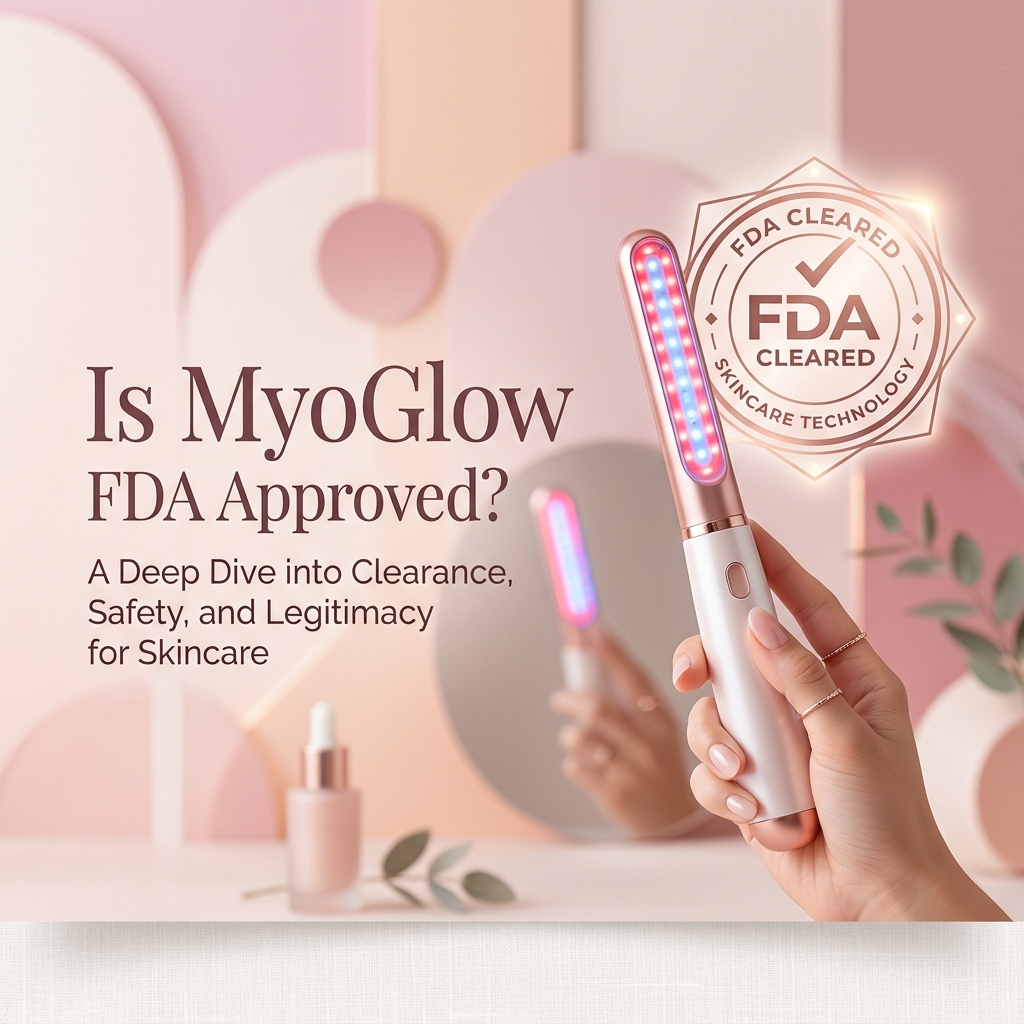
MyoGlow is not FDA approved in the way drugs or surgical implants are. It is an FDA-registered device that likely holds 510(k) clearance for safety, placing it in a cosmetic device category with regulatory oversight but no government performance endorsement.
Key Takeaways
- "FDA approved" is a term reserved for high-risk medical devices and drugs; MyoGlow falls under a different regulatory classification.
- The device is FDA registered and likely cleared, confirming it meets baseline safety requirements for home use on skin.
- Registration and clearance do not guarantee results or effectiveness; they mean the device is safe when used as directed.
- Most light-based skin tools on the market are similarly classified, so MyoGlow’s status is normal and expected for its category.
- Trust should be built from the 90-day guarantee and transparent customer reviews rather than a regulatory stamp.
What FDA Approval Actually Means
The term "FDA approved" is frequently misunderstood. The FDA classifies products based on risk, and only the highest-risk categories undergo the full approval process.
- FDA Approval: Required for Class III medical devices (implants, pacemakers) and new drugs. This involves rigorous clinical trials proving safety and effectiveness.
- FDA Clearance (510(k)): Applies to Class II devices that are substantially equivalent to an existing legally marketed device. Most at-home skin devices fall here.
- FDA Registration: The manufacturer registers their facility and lists the device with the FDA. It does not require pre-market review, and it is not an endorsement.
This hierarchy matters because it clarifies that a device can be fully legal to sell, safe, and effective without being "approved." MyoGlow operates within this framework.
MyoGlow’s Regulatory Status
MyoGlow uses red light therapy, micro-sculpting, thermal warmth, and massage. Devices with these features are typically classified as Class II medical devices intended for temporary skin tightening or wrinkle reduction.
The manufacturer likely submitted a 510(k) premarket notification, demonstrating that MyoGlow is substantially equivalent to other legally marketed light-based skin devices. Once cleared, the product is listed in the FDA’s database, and the manufacturer can legally sell it in the U.S.
The packaging or manual may reference “FDA cleared” or “FDA registered.” If it says “FDA approved,” that would be inaccurate for this device class.
Why This Distinction Matters for You
Understanding the regulatory nuance helps you set realistic expectations and spot marketing language that may be overstated.
- Safety Assurance: A cleared or registered device has met baseline safety standards. That means no dangerous electrical faults, thermal burns, or unlabeled risks when used correctly.
- Performance Gap: Efficacy is not guaranteed by the FDA. MyoGlow’s visible results come from its technology, not from a government stamp. User reviews and the 90-day guarantee provide a better window into likely outcomes.
- Industry Norm: Leading brands like NuFACE and Solawave have similar FDA clearances; MyoGlow’s status is standard, not exceptional.
How MyoGlow Compares to Cleared vs. Non-Cleared Alternatives
Some skincare devices on the market have no FDA clearance, operating purely as cosmetic gadgets with minimal oversight. MyoGlow’s likely clearance puts it in a safer tier.
| Regulatory Status | Safety Review | Efficacy Review | Example Products | Consumer Takeaway |
|---|---|---|---|---|
| FDA Approved (Class III) | Yes, extensive | Yes, clinical trials | Pacemakers, dermal fillers | Highest confidence; not applicable to home devices |
| FDA Cleared (Class II, 510(k)) | Yes, substantial equivalence | No performance mandate | MyoGlow, NuFACE, Solawave | Safer tier; effectiveness relies on technology and user reviews |
| FDA Registered Only | Minimal (facility listing) | None | Some low-cost gadgets | Lower oversight; safety claims may be unverified |
This table shows that MyoGlow’s likely classification aligns with trusted brands, offering reasonable safety assurance without a false halo of "approval."
Pros and Cons of MyoGlow’s Regulatory Approach
Pros:
- FDA clearance indicates review of safety and electrical standards
- Same classification as established, reputable competitors
- Transparent labeling allows informed use
- No overhanging risks of unregulated energy exposure
Cons:
- Does not carry the higher bar of "FDA approved" (and some buyers may find that misleading if not educated)
- Individual results still vary significantly despite clearance
- No U.S. government data on effectiveness exists
Verdict: MyoGlow’s regulatory status is appropriate for a non-invasive home device and should not deter purchase, especially given the risk-free guarantee.
Conclusion
The question “Is MyoGlow FDA approved?” reveals a consumer who values safety and legitimacy. The honest answer is that it doesn’t need full FDA approval to be a safe, well-built device. What matters more is that MyoGlow adheres to recognized safety standards, likely holds a clearance that authorizes its sale, and backs its promises with a 90-day refund window. If you rely on stamps alone, you might miss the bigger picture: consistent daily use and a solid guarantee tell you far more about what a product can do for your skin.
Frequently Asked Questions
Is MyoGlow FDA approved?
Does FDA clearance mean MyoGlow will definitely work for me?
Is it safe to use a device that lacks full FDA approval?
How can I verify MyoGlow’s regulatory status?
Where to Buy & Learn More
Buy Now at the Official Website:
https://secureofficialsite.store/buy-myoglow
Learn More on the Official Site:
usa-myoglow.com